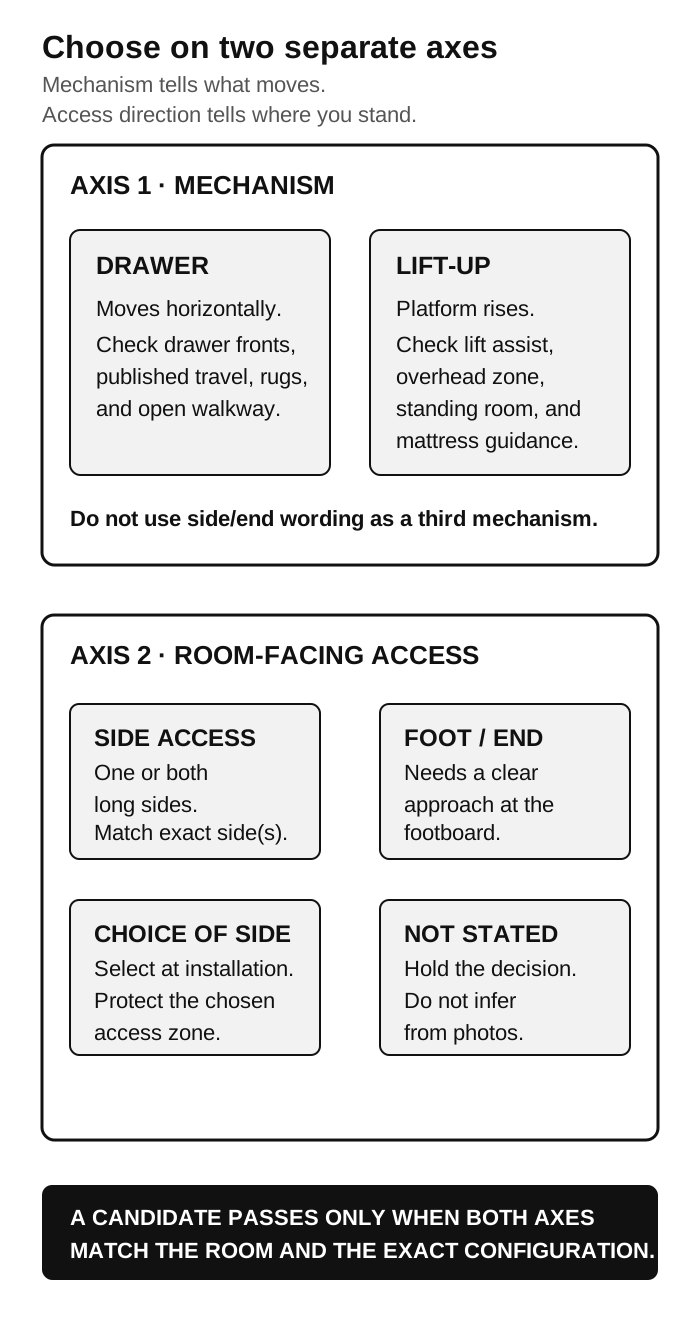
A storage bed only earns its footprint if you can reach what is inside it. Make the decision on two separate axes. First identify the mechanism: drawers pull horizontally, while a lift-up platform raises the mattress. Then identify the room-facing access direction: both long sides, one side, the foot/end, an install-time choice of side, or not stated. A side-opening lift-up bed is still a lift-up mechanism, and a drawer bed can require side, foot, or multiple access zones.
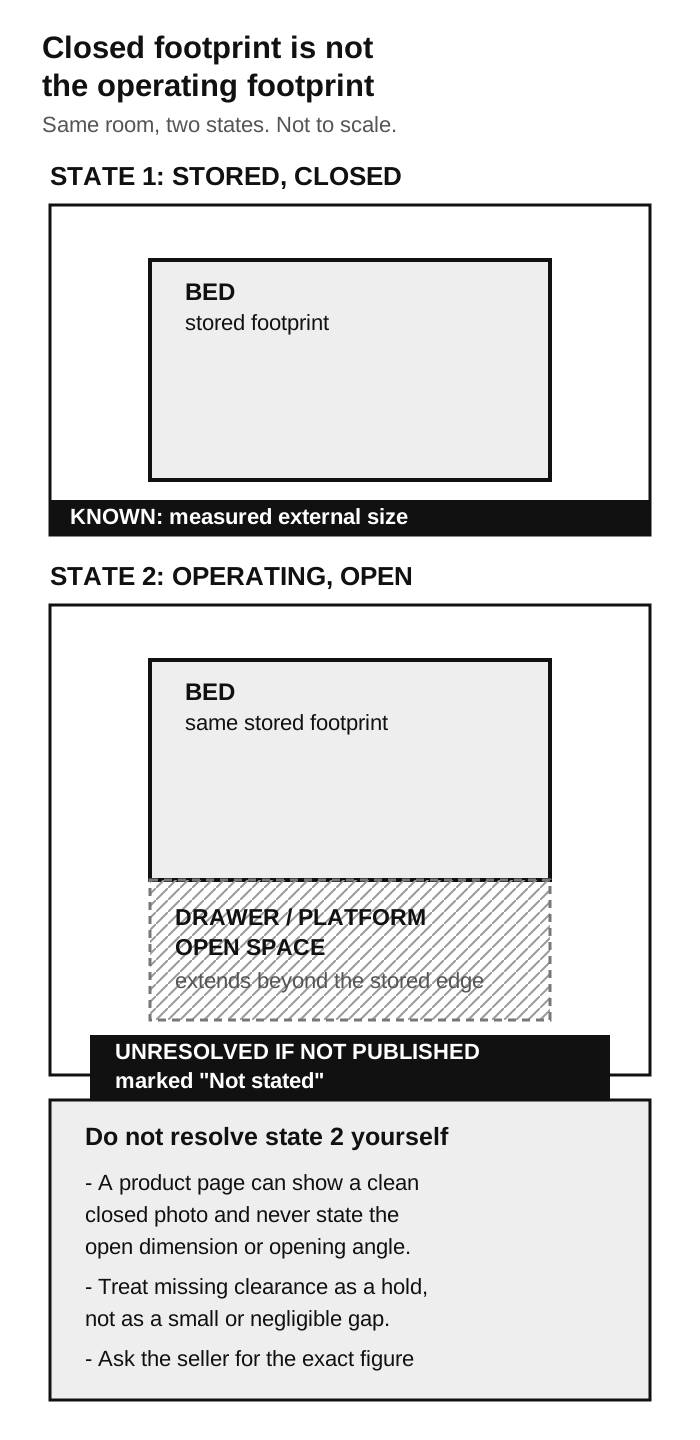
A closed footprint can fit perfectly and still fail in daily use. What matters is the operating footprint: the floor and wall space a drawer needs to fully extend, or the overhead, standing, side, and end space required to operate the exact lift platform. A bed that measures fine while closed can still catch a drawer on a nightstand or rug, place its lift handle against a wall, or need more overhead room than a low ceiling allows.
This guide draws on 24 inspected model families across official product pages and marketplace listings, captured and audited October 1, 2026, plus two flagged reports from one Reddit discussion. It is not a hands-on test; we did not buy, assemble, open, or load-test any of these beds. Where the inspected sources omit a figure, this guide says so instead of estimating one.
The short answer: which mechanism and access direction fit?
| Decision axis | Option | What it controls | What to verify |
|---|---|---|---|
| Mechanism | Drawer | Storage moves horizontally on slides, glides, castors, or brackets | Drawer-front location, travel, rug clearance, and open walkway |
| Mechanism | Lift-up platform | Mattress platform tilts or rises on hinges, struts, or pistons | Operating position, overhead zone, standing room, mattress guidance, and lift assist |
| Access direction | Side access | User operates storage from one or both long sides | The exact side or sides stated for the chosen configuration |
| Access direction | Foot/end access | User operates storage from the foot or end | Footboard clearance, door swing, bench, and walking route |
| Access direction | Choice of side | Operating side is selected during installation | Confirm the chosen side before assembly and preserve that access zone |
| Access direction | Not stated | Source does not establish a room-facing operating side/end | Hold the decision until the seller or assembled product confirms it |
Separate advertised storage volume from what you can actually use. A brand may describe “spacious” or “deep” storage without publishing interior dimensions or drawer travel. A compartment’s length and width tell you floor space covered, not whether you can reach the back once a drawer is only partly open.
Use this scoring before any product reaches your shortlist:
| Result | Decision rule |
|---|---|
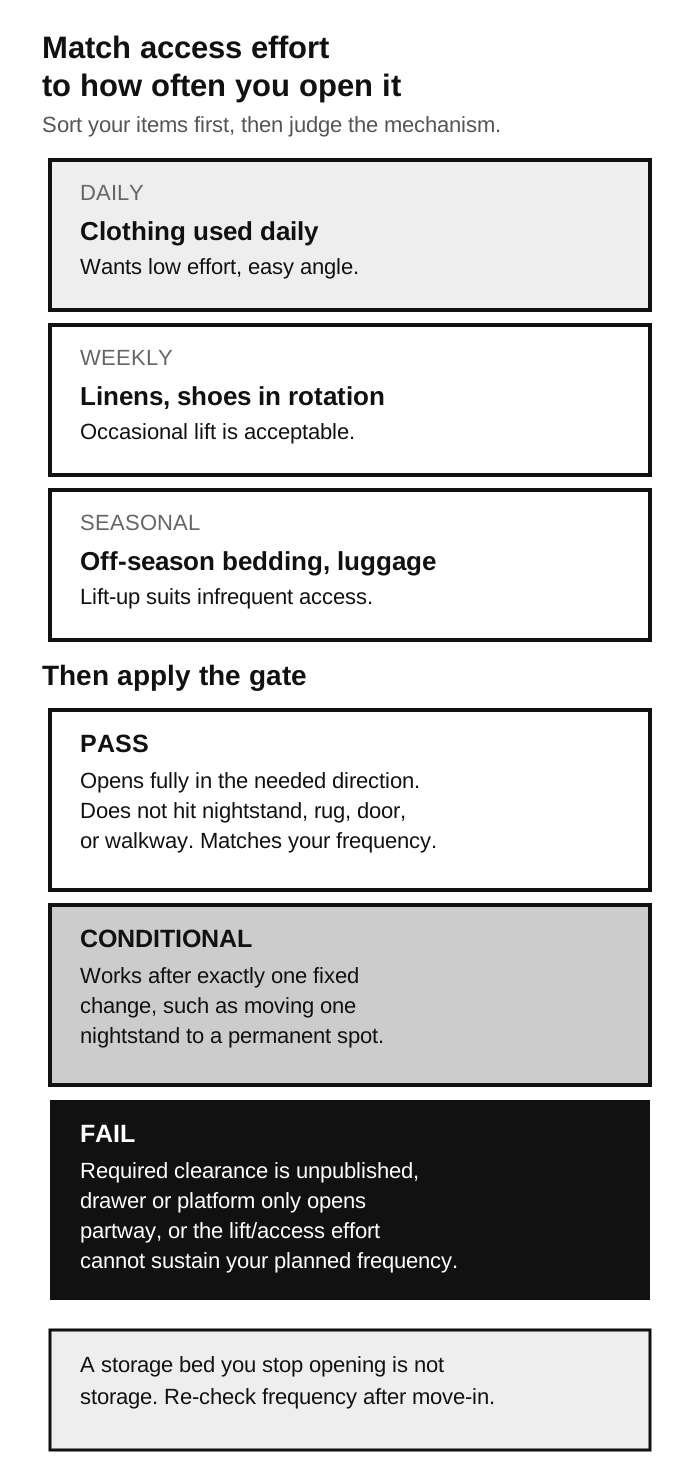
| Pass | The bed opens fully in the direction your room allows, does not collide with a nightstand, rug, door swing, or walkway, and supports the access frequency you need. |
| Conditional | One accepted, predefined change closes the gap, such as moving a single nightstand to a fixed spot. |
| Fail | A needed clearance figure is not published, the drawer or platform opens only partway in your room, or lifting effort or reach makes your intended frequency unrealistic. |
Drawer storage beds
A drawer storage bed works like a dresser built into the base: drawers slide out horizontally, usually along one or both long sides. Access is direct, and you see the whole compartment once a drawer is open.
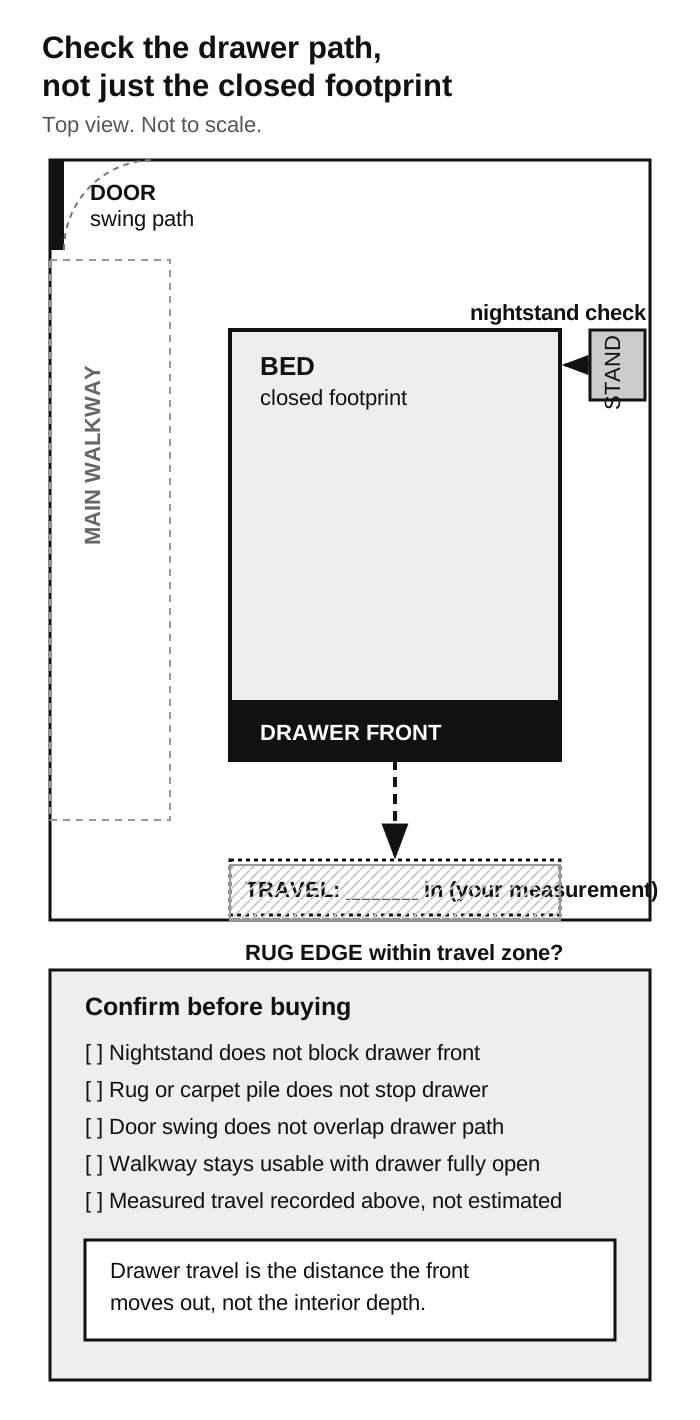
The failure mode is rarely the drawer itself, but what it runs into. Walk its exact path and check against:
- Nightstands. One placed at the head of the bed can block a same-side drawer from opening past its front face, even without touching the frame.
- Rugs. A rug edge or trim can catch a drawer’s bottom or rollers, especially on low-set drawers.
- Doors. A door swinging into the room can occupy the same floor area a side drawer needs when fully extended.
- Walkways. The main path to the room’s entry or closet needs to stay usable while a drawer is fully open, not only closed.
Pottery Barn’s Raleigh Upholstered Square Storage Bed shows why you should check the exact configuration rather than assume from a photo. The brand sells side-drawer and footboard-drawer versions as separate, mutually exclusive options on the same frame: side storage means four drawers, two per side; footboard storage means one drawer at the foot. They are not combined. A different Pottery Barn model, the Stratton in the audit table below, has its own six-drawer layout.
Drawer beds can suit frequent access when the exact drawer fronts face clear floor, since nothing must be lifted and the compartment stays visible once open. That advantage disappears when the published drawer locations face a wall, nightstand, or blocked walkway. A room with clear floor only at the foot needs a foot-access drawer configuration; it cannot assume that any drawer bed will work.
When comparing drawer beds, record drawer count and side/end location, interior compartment dimensions, published travel distance, any stated drawer weight limit, and whether each drawer opens independently.
Lift-up storage beds
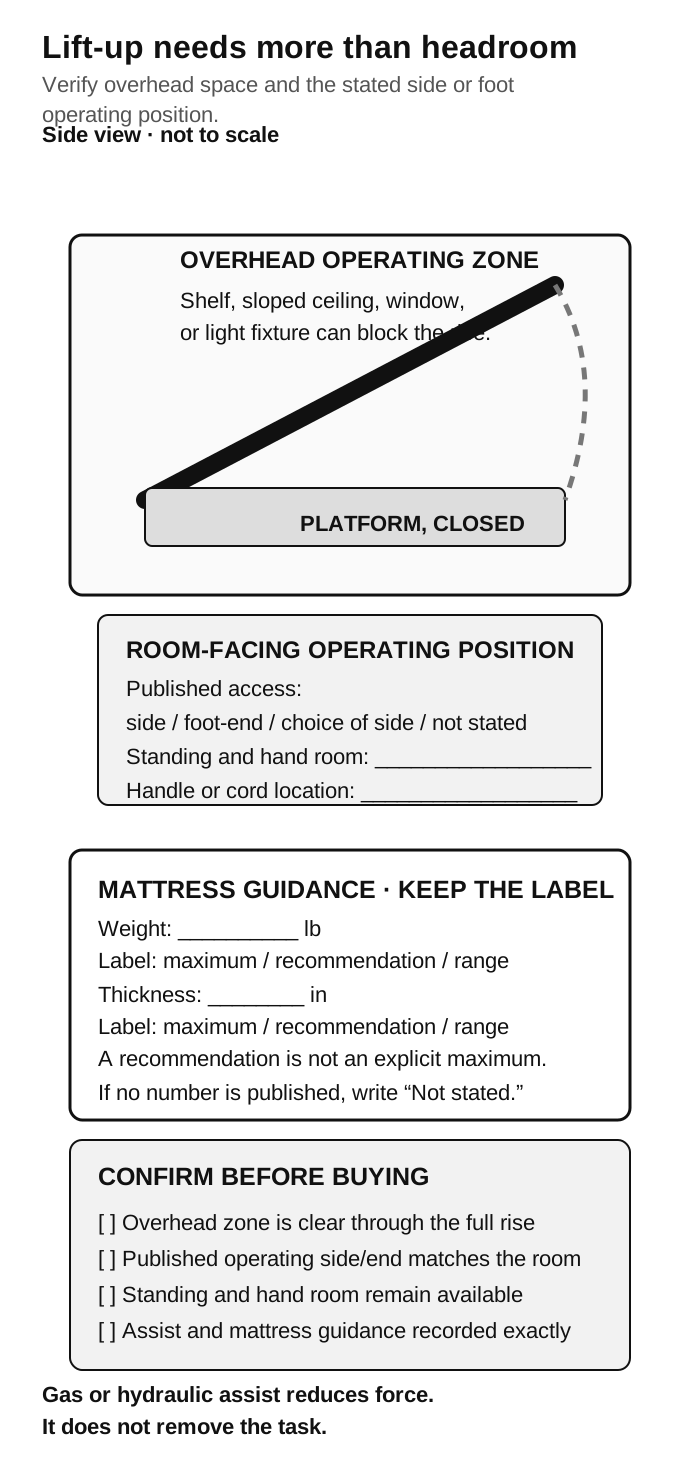
A lift-up storage bed hinges the mattress platform upward, usually from one long side or the foot, to reveal a cavity underneath. Several inspected listings identify gas-piston or hydraulic assistance; that is an aid, not proof that every user or mattress will be easy to lift.
A lift-up design may avoid horizontal drawer travel, but it still needs a verified operating zone: headroom for full rise, the stated side or foot operating position, room to stand and lift, and any wall or headboard gap required by the exact mechanism.
Confirm four things before treating a lift-up bed as fit for daily use:
- Mattress weight. The mechanism lifts the mattress and moving platform. A range, rather than a single maximum, signals the assisted lift was designed around that range, not beyond it.
- Mattress thickness. Follow the exact fit guidance. Some brands publish a range; others only say a bed “accommodates most standard mattresses,” which is qualitative, not measurable.
- Lift assist type. A gas-piston or strut reduces the force needed, but does not eliminate it, and is not engineered for every mattress weight or every person’s strength. A mechanism description is not the same as a published maximum the assist was built for.
- Access direction. Some lift-up beds state side access and let you choose the operating side at installation. Others place the operating cord at the foot. Vertical lift motion alone does not identify the room-facing access side or end.
Frequency matters as much as mechanism. A lift-up bed storing off-season bedding may open only a few times a year, so some households may accept more lifting effort. The same bed holding everyday clothing turns that effort into a daily task, and a platform needing two hands and deliberate motion is a worse fit than a drawer.
Access direction: side, foot/end, choice of side, or unstated
Access direction is the second axis, not a third mechanism. For a drawer bed, source text may locate operable drawer fronts on one or both long sides or at the footboard. For a lift-up bed, source text may state side access, a choice of operating side at installation, or a user operating position at the foot. A statement that the platform simply rises vertically describes mechanism motion, not the room-facing access direction.
Treat an access direction as verified only when the seller’s own text states the operating side/end or explicitly locates the drawer fronts. Do not infer it from an image or product name. Keep drawer-front location, user operating position, hinge geometry, and complete operating footprint as separate claims.
Once verified, match that access direction against your room’s reach distance and main walkway. A configuration operated from the right side is not interchangeable with a room that only has floor space on the left. A foot-operated lift or footboard drawer also needs its own clear approach zone.
Measure the operating footprint, not just the closed one
- Measure the bed’s external dimensions in its closed, stored state, using the units the seller publishes.
- Measure from each edge of the bed to the nearest wall, furniture, and door swing, in every direction relevant to the mechanism.
- Mark the drawer’s travel path or the lift platform’s operating zone on the floor with tape, using published figures where they exist.
- For a lift-up bed, check what sits above it: a shelf, window, sloped ceiling, or light fixture can block full rise even with clear floor space.
- Decide, before buying, how often you intend to open this storage: daily, weekly, or seasonal. That decision changes which mechanism and effort level is acceptable.
- Check the delivery route through entrances, hallways, and stairs. If package dimensions or counts are published, measure each package against that route.
Do not calculate an operating footprint by adding a mattress dimension to the closed frame’s depth, or treat a rendered image as a substitute for a stated number. If a figure is missing, mark it unresolved and verify it with the seller or on the assembled product before relying on it.
For the room-level version of this process, including the bed’s relation to a desk, closet, and door, see the small bedroom layout guide. This article stays focused on the storage mechanism itself.
Compare by usable access, not claimed capacity
Compare candidates using the same fixed fields, and leave a field blank rather than estimate it:
- mechanism and, separately, the source-stated room-facing access direction;
- external dimensions closed, with the source’s original units;
- drawer travel distance, or the lift platform’s stated operating clearance;
- drawer or compartment interior dimensions, kept separate from outer or front-facing dimensions;
- mattress weight and thickness guidance, kept as separate figures and labeled as a recommendation, range, or explicit maximum exactly as stated;
- lift assist type, for lift-up designs;
- assembly and delivery details, including package count where published;
- warranty terms, kept separate from the return policy;
- the source URL and the date checked.
Do not estimate an unpublished storage volume from a bed’s external dimensions. A frame’s outer footprint includes the mattress platform, side rails, and headboard material the compartment does not use, so calculating volume from outside measurements overstates what actually fits inside.
Which mechanism and access pattern fit your room?
| Your room or need | Starting point |
|---|---|
| Clear floor beside published drawer fronts | Drawer, after checking travel and walkway clearance |
| Horizontal drawer travel is blocked, but a verified lift operating position is clear | Lift-up, with access direction, mattress guidance, and lift assist confirmed |
| Only the foot is reachable | A footboard-drawer or foot-operated lift configuration explicitly stated for that exact model |
| Only one long side is reachable | A one-side or install-time choice-of-side configuration set to that exact side |
| Daily clothing storage | A low-effort mechanism with verified access at the frequency you need; often a correctly oriented drawer |
| Seasonal bedding or off-rotation items | Lift-up can be considered when its operating zone and effort are acceptable |
| A lifting limitation for any household member | Skip lift-up designs where operating force is unverified; favor accessible drawers with confirmed fronts |
Seven representative configurations from the source audit
The table below is a specification audit, not a ranking. Every figure comes from the brand’s official product page. Not stated means the inspected page omitted that field; it does not prove the feature is absent. Mechanism and access direction remain separate columns, and none supplied a complete operating footprint.
| Product · source | Mechanism | Room-facing access direction (as published) | Closed external dimensions | Drawer travel / storage compartment | Mattress weight / thickness guidance | Key limitation to resolve |
|---|---|---|---|---|---|---|
| Floyd — Underbed Storage Add-On · brand-listed | Add-on slides under the Floyd Bed Frame on attached brackets | Not stated | Add-on 44.5″W × 20″D × 5″H | Extends 15.5″ out fully opened; interior 40.5″W × 14.75″D × 4.75″H | Not applicable; add-on holds up to 80 lb, a storage-basket limit | Bed-frame accessory, not a complete bed; footprint beyond the 15.5″ extension is not stated |
| West Elm — Andes Side Storage Bed · brand-listed | Side-mounted pull-out drawer slides | Both long sides; 2 pull-out drawers per side | 66″w × 87″d × 46″h | Drawers extend 19″; interior (4) 28″w × 21″d × 5.75″h | 600-lb figure is a general bed capacity, not confirmed mattress-specific; thickness not stated | Resolve mattress guidance separately |
| IKEA — MALM High bed frame/2 storage boxes · brand-listed | Storage boxes roll out on castors, not a lift platform | Not stated | L83 1/8″ × W66 1/8″ × H39 3/8″ | Roll-out travel not stated; interior H5 7/8″ × W38 5/8″ × D23 1/4″ | Not stated | No roll-out distance published, and no weight-capacity figure is published at all |
| Pottery Barn — Stratton Storage Platform Bed with Drawers · brand-listed | Not stated (no slide/mechanism term on the page) | Both long sides and footboard; 2 drawers at each location | 60″w × 79.5″d × 16″h | Travel not stated; interior 24″w × 16″d × 10″h | 600-lb figure is a general capacity, not confirmed mattress-specific; thickness not stated | Drawer location is published, but pull direction and travel are not |
| Expand Furniture — Reveal: Queen Side Lifting Storage Bed · brand-listed | Side-lifting platform on a hydraulic gas piston system | Side access; buyer chooses the operating side at installation | L86.22″ × W64.5″ × Base H16.5″ × Headboard H39.7″ | Storage height 13″; side lift clearance not stated | Minimum 40 lb, maximum 140 lb, with the brand recommending 100 lb or under; thickness not stated | Maximum and recommended weight are not interchangeable |
| West Elm — Haven Pop-Up Storage Bed with Easy Lift · brand-listed | Mattress platform lifts via a cord at the foot, with a gas-lift mechanism | User operates it from the foot; hinge side and raised footprint not stated | 46″w × 87.5″d × 38″h | Storage space 41.5″w × 77″d × 5″h | 300-lb figure is a general bed weight capacity, not confirmed mattress-specific; thickness guidance is qualitative only | No numeric mattress thickness maximum is published, only a qualitative statement |
| Castlery — Dawson Storage Bed · brand-listed | Gas-lift platform | Not stated; neither a side nor an end access position is published | W76.8″ × D98.4″ × H37″ | Storage inner dimension W60.6″ × D81.1″ × H9.8″ | Recommended (not maximum) weight 88.2–110.2 lb; recommended (not maximum) thickness 7.9″–11.8″; separate max bearing support 793.7 lb | Room-facing access direction is unpublished, and 793.7 lb is a bearing-support spec, not the mattress recommendation |
Across the full 24-model-family dataset this table draws from, 0 of 24 published a complete operating footprint, and only 6 of 24 explicitly published a room-facing access direction. The six are West Elm Andes, Pottery Barn Stratton, Pottery Barn Raleigh Siderail, DWR Matera, Expand Furniture Reveal, and West Elm Haven. Vertical lift motion by itself was not counted. This is a sample-limited finding about these model families, not the market overall.
Worked fit gate: Floyd publishes 15.5 inches of drawer extension. It is a Pass only if your measured path clears that distance plus every fixed obstacle and required walkway. It is Conditional if one accepted move, such as relocating a nightstand, creates that path. It is a Fail if the measured path is shorter or the open drawer blocks a route you need.
What buyers actually run into
A single Reddit thread asked whether underbed drawers were worth it in a small apartment. Two individual replies are useful as concrete problem reports, not as evidence of how common these issues are across storage beds generally. One commenter switched from a side-drawer bed to a lift-up design after finding drawers could not open fully in a narrow room. Another described a nightstand that blocked front access to a same-side drawer, even though it never touched the frame. Both are single accounts from one discussion, not a survey, and should not be read as typical outcomes.
FAQ
What is the fastest way to know which storage bed mechanism to buy?
First choose the mechanism: drawer or lift-up. Then match the exact product’s published access direction to the clear side or end of your room. A lift platform that rises vertically still needs a stated operating position; a drawer bed still needs drawer fronts facing clear floor.
How much clearance do drawer storage beds need?
It depends on the bed’s published drawer travel distance, which varies by model, plus whatever furniture, rugs, doors, or walkways sit along that path. There is no single clearance figure for every drawer bed; use the manufacturer’s stated distance and measure your room against it.
Is a lift-up storage bed hard to open?
Gas-assist struts cut the lifting force, not the whole task. Check the stated mattress range and who in the household will actually open it.
Can bedding stay on the bed while a lift-up storage bed is open?
Do not assume bedding can stay in place. A staged photo does not prove loose pillows, a bed skirt, or fitted sheets will clear the mechanism; treat this as unresolved unless the listing or manual addresses it.
Is side-opening a separate storage-bed mechanism?
No. Side-opening describes access direction. The mechanism underneath may be a drawer or a lift-up platform. Confirm both axes independently: what physically moves, and from which side or end the user operates it.
Do storage beds use standard mattresses?
Often, but not always. Some pages confirm standard mattress sizes; others publish a weight or thickness range a standard mattress may exceed. Confirm the specific figures for the exact model rather than assuming compatibility from the bed size alone.
Final checklist
Before you buy, confirm each of the following for the exact model and configuration:
- you have selected the mechanism, drawer or lift-up, independently from the access direction;
- you have matched the source-stated side, foot/end, or choice-of-side access to the room’s reachable zone;
- you have the published drawer travel distance or lift operating clearance, or flagged it unstated and plan to verify it before purchase;
- you have checked the drawer or lift path against nightstands, rugs, doors, and the main walkway;
- you have decided whether use is daily, weekly, or seasonal, and matched that to the mechanism’s real effort level;
- for a lift-up bed, you have the mattress weight range, thickness guidance, and lift assist type, and have not assumed the assist makes lifting effortless for every user;
- you have not estimated storage volume, clearance, hinge geometry, or access direction from a photo or the bed’s outer dimensions;
- you have confirmed assembly and delivery details, including package count, against your delivery route;
- you have kept any recommended figure and any explicit maximum figure separate, rather than interchangeable.
A storage bed is only as useful as the access it provides once it is in your room, fully open, on the day you need it. Match the mechanism to your walls and habits first, and let the spec sheet confirm the fit rather than define it.
Browse the storage beds pillar for related comparisons, including the loft bed for adults guide for rooms where floor space matters more than underbed storage. See our Editorial Policy for how we separate published specifications from editorial judgment.